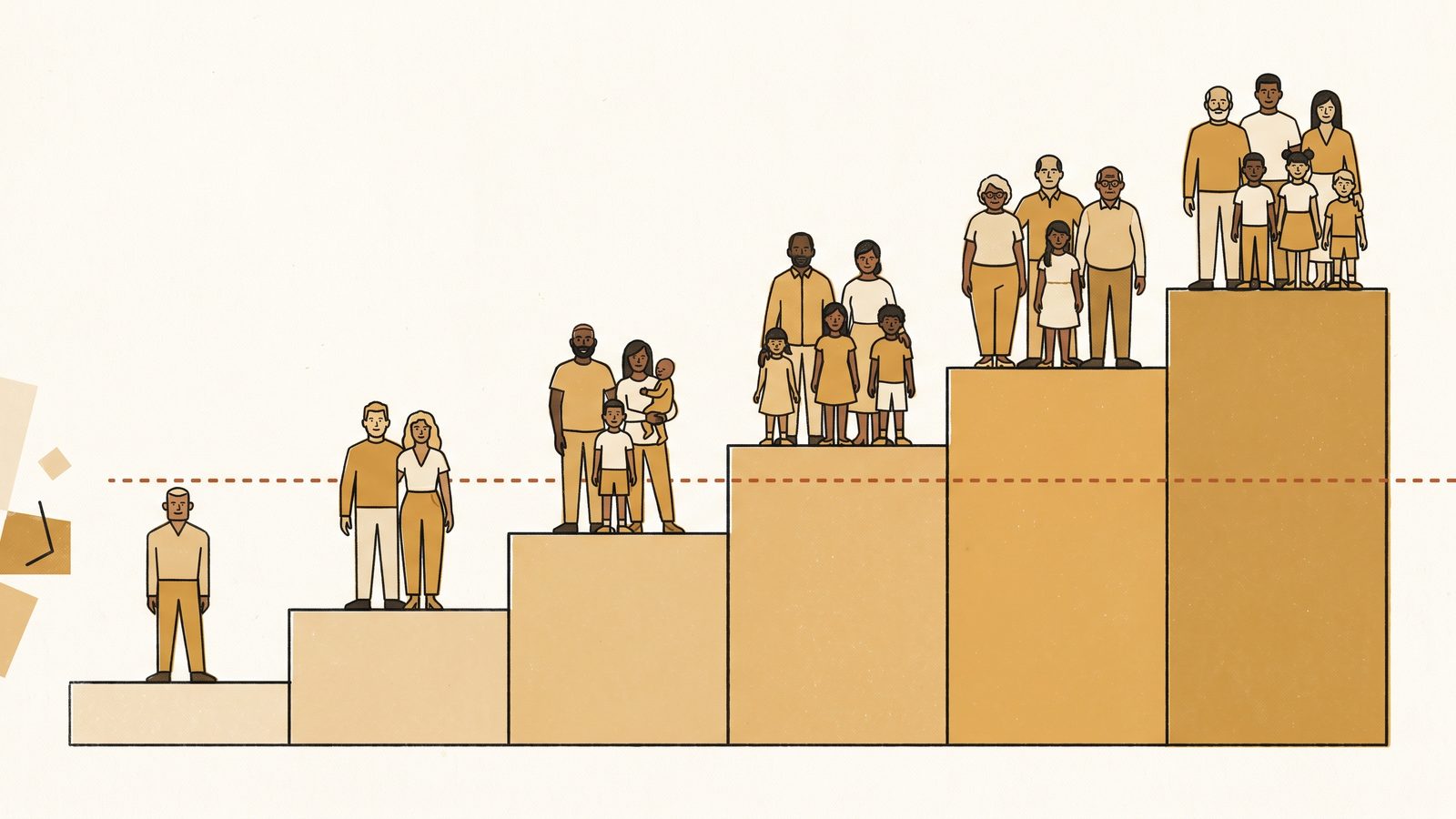
The full table
| Household | 100% | 138% Medicaid | 200% Essential Plan · financial aid | 300% hospital: 10% cap | 400% hospital: 20% cap · no lawsuits · NYC Care · Child Health Plus |
|---|---|---|---|---|---|
| 1 | $15,960 | $22,024 | $31,920 | $47,880 | $63,840 |
| 2 | $21,640 | $29,863 | $43,280 | $64,920 | $86,560 |
| 3 | $27,320 | $37,701 | $54,640 | $81,960 | $109,280 |
| 4 | $33,000 | $45,540 | $66,000 | $99,000 | $132,000 |
| 5 | $38,680 | $53,378 | $77,360 | $116,040 | $154,720 |
| 6 | $44,360 | $61,216 | $88,720 | $133,080 | $177,440 |
| 7 | $50,040 | $69,055 | $100,080 | $150,120 | $200,160 |
| 8 | $55,720 | $76,893 | $111,440 | $167,160 | $222,880 |
Each additional person adds $5,680 to 100% FPL. Annual figures, before taxes.
What each column decides
100% FPL. The base figure. Nothing is set at exactly 100%; everything is a multiple of it.
138%: Medicaid for most working-age adults without dependent children. Broader coverage than anything else in the state, and the only program covering long-term care. Applications accepted year-round. Pregnant patients and children qualify at substantially higher incomes. Details.
200%: two things at once. The Essential Plan ceiling for ages 19 to 64: $0 premium, no deductible, no enrollment season. And the line at or below which a New York hospital may not charge an uninsured patient anything out of pocket for emergency and medically necessary care.
300%: the 10% cap. Between 201% and 300%, an uninsured patient may not be charged more than 10% of what Medicaid would have paid for the service. Since the Medicaid rate is typically a fraction of the list price, this is a much larger reduction than it sounds.
400%: four rules. Between 301% and 400%, a hospital may not charge more than 20% of the Medicaid rate, a tier added in October 2024, and no hospital may sue a patient whose income is under this line. It is also where the NYC Care sliding scale ends, and, for 2027 plans, where the marketplace premium tax credit generally ends now that the enhanced credits have expired. How to invoke the hospital rules.
Child Health Plus: what a family pays per child
Child Health Plus covers children under 19 regardless of immigration status, and the monthly premium depends on family income. Per the state Department of Health’s table for 2026:
| Household | 222% free up to here | 250% $15 per child | 300% $30 per child | 350% $45 per child | 400% $60 per child |
|---|---|---|---|---|---|
| 1 | $35,431 | $39,900 | $47,880 | $55,860 | $63,840 |
| 2 | $48,040 | $54,100 | $64,920 | $75,740 | $86,560 |
| 3 | $60,650 | $68,300 | $81,960 | $95,620 | $109,280 |
| 4 | $73,260 | $82,500 | $99,000 | $115,500 | $132,000 |
| 5 | $85,869 | $96,700 | $116,040 | $135,380 | $154,720 |
| 6 | $98,479 | $110,900 | $133,080 | $155,260 | $177,440 |
Each additional person adds $5,680 to 100% FPL. Annual figures, before taxes.
The premium is charged for at most three children: a family with four children in the $15 tier pays $45 a month in total. Above 400% of the poverty level the family pays the full premium, which varies by plan. How to apply.
Two rules that override the table
Children. Child Health Plus covers under-19s at family income limits well above the adult thresholds, and without any immigration requirement. A household that qualifies for nothing as adults frequently qualifies for its children.
Pregnancy. Medicaid income limits for pregnant patients are substantially higher than for other adults. Report a pregnancy on the application rather than assuming the adult table applies.
What counts as income
Household income before taxes, projected for the current year, not last year’s tax return if this year looks different. Certain pre-tax deductions reduce the figure the programs measure: retirement contributions, HSA contributions, deductible self-employment expenses. That is the legitimate mechanism by which a household lands under a threshold it appeared to be over.
Not counted: SNAP, most child support, Supplemental Security Income, workers’ compensation, veterans’ disability benefits, gifts and inheritances. Full definition: MAGI.
When these numbers change
HHS publishes updated poverty guidelines each January, and every threshold on this page moves with them. In 2025 the base was $15,650 plus $5,500 per person; in 2026 it rose to $15,960 plus $5,680. We recalculate when they do, and the date at the top of this page is when we last checked. If you’re reading this in a later year, check the current guidelines before relying on a figure.
Use this on your own site
Community organizations, clinics and caseworkers are welcome to embed the eligibility navigator. It loads no trackers, sets no cookies, and sends nothing anywhere. Paste this where you want it:
<iframe src="https://nycmednews.com/embed/eligibility/"
        width="100%" height="720" style="border:1px solid #ddd;border-radius:6px"
        title="New York health coverage eligibility navigator"
        loading="lazy"></iframe>
The table on this page is also free to reproduce with attribution to NYC Med News and a link back. If you need it as a printed handout, the page prints cleanly: the navigation and sidebars drop out automatically.
Questions people ask
Are these New York numbers or federal ones?
The poverty guidelines are federal and apply to the 48 contiguous states; the percentages attached to them are New York’s program rules.
Why does 200% appear twice?
Because two different laws use the same line: Essential Plan eligibility and the point at or below which a hospital may not bill an uninsured patient out of pocket. Same number, different laws.
What are the Essential Plan income limits for 2026?
200% of the federal poverty level: $31,920 for one person, $43,280 for two, $54,640 for three, $66,000 for four. The Essential Plan income limits page goes through what counts as income and what to do if you are just over.
Do these apply to Medicare?
No. Medicare eligibility runs on age and disability, not income, though low income can qualify a Medicare enrollee for Medicaid as well.
My income is right at a threshold. What now?
Apply. Programs verify with documents and use their own calculation; a table is a guide, not a decision. And check household size and pre-tax deductions first: both move the line legitimately.
Sources
- HHS 2026 Poverty Guidelines (Federal Register, January 15, 2026) (checked 2026-09-07)
- NY State of Health — Essential Plan (checked 2026-09-07)
- New York State Attorney General — Hospital financial assistance (checked 2026-09-07)
- NYS Department of Health — Child Health Plus eligibility and cost (checked 2026-09-07)
- NYC Care (checked 2026-09-07)
More in Coverage
- Running a Small Business: What You Owe, What You Do Not, and What You Are Missing — Below 50 employees you need not offer coverage; below 20 you are outside federal COBRA but not New York's continuation. Workers' compensation still applies.
- You Just Lost Coverage: The First Week — Job loss, turning 26, a move, a divorce — each opens a 60-day window. What to do in the first days, and which New York programs ignore the calendar entirely.
- Which Health Program Are You Likely Eligible For in New York? — Answer five questions and see which New York health coverage programs are open to you — Medicaid, the Essential Plan, Child Health Plus, NYC Care, marketplace plans. Runs in your browser.
This page explains how the system works. It is not medical advice. More.